
Introduction to Ideology
What is Ideology?
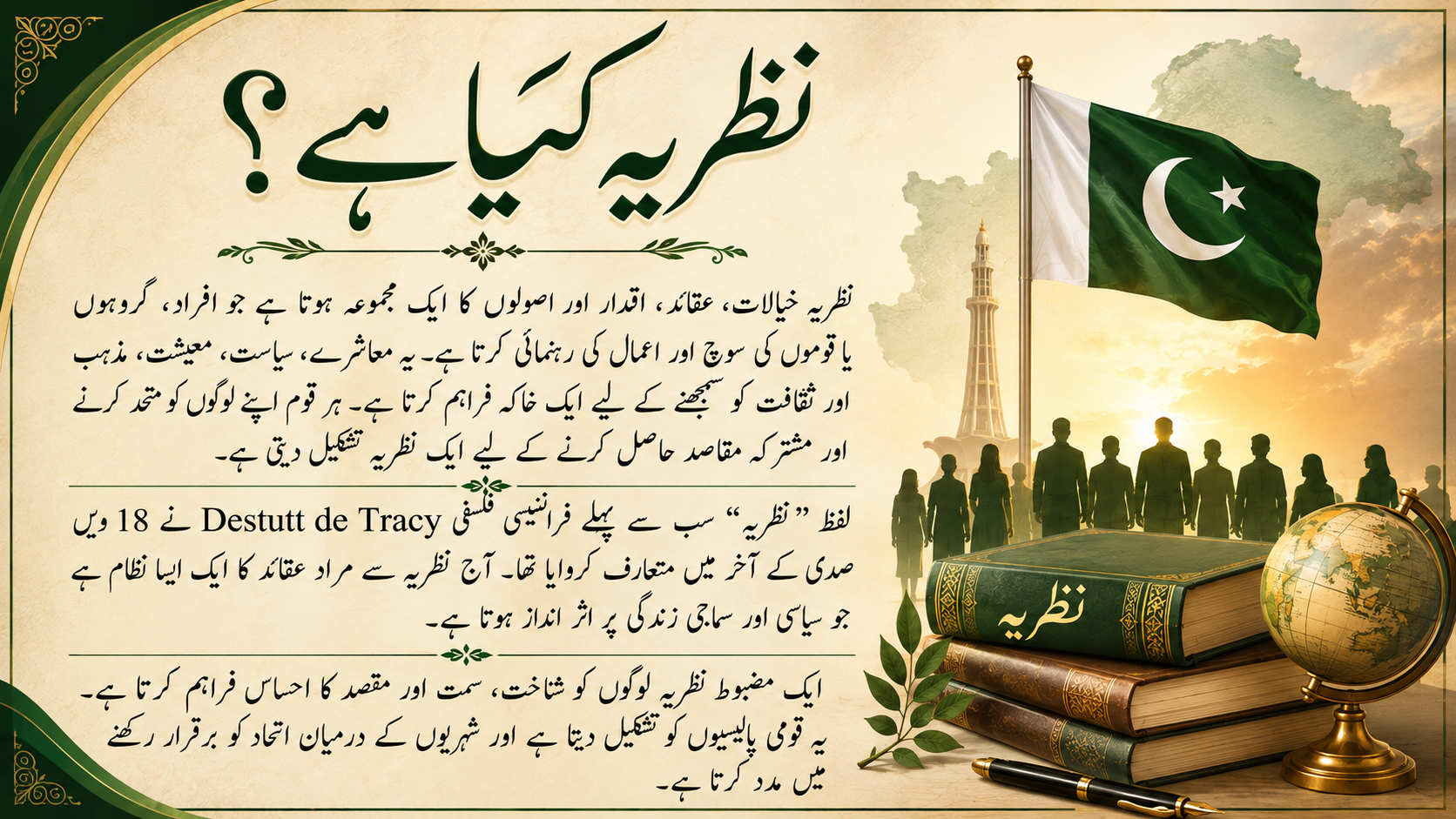
Ideology is a set of ideas, beliefs, values, and principles that guide the thinking and actions of individuals, groups, or nations. It provides a framework for understanding society, politics, economics, religion, and culture. Every nation develops an ideology to unite its people and achieve common goals.
The word “ideology” was first introduced by the French philosopher Destutt de Tracy in the late 18th century. Today, ideology refers to a system of beliefs that influences political and social life.
A strong ideology gives people a sense of identity, direction, and purpose. It shapes national policies and helps maintain unity among citizens.
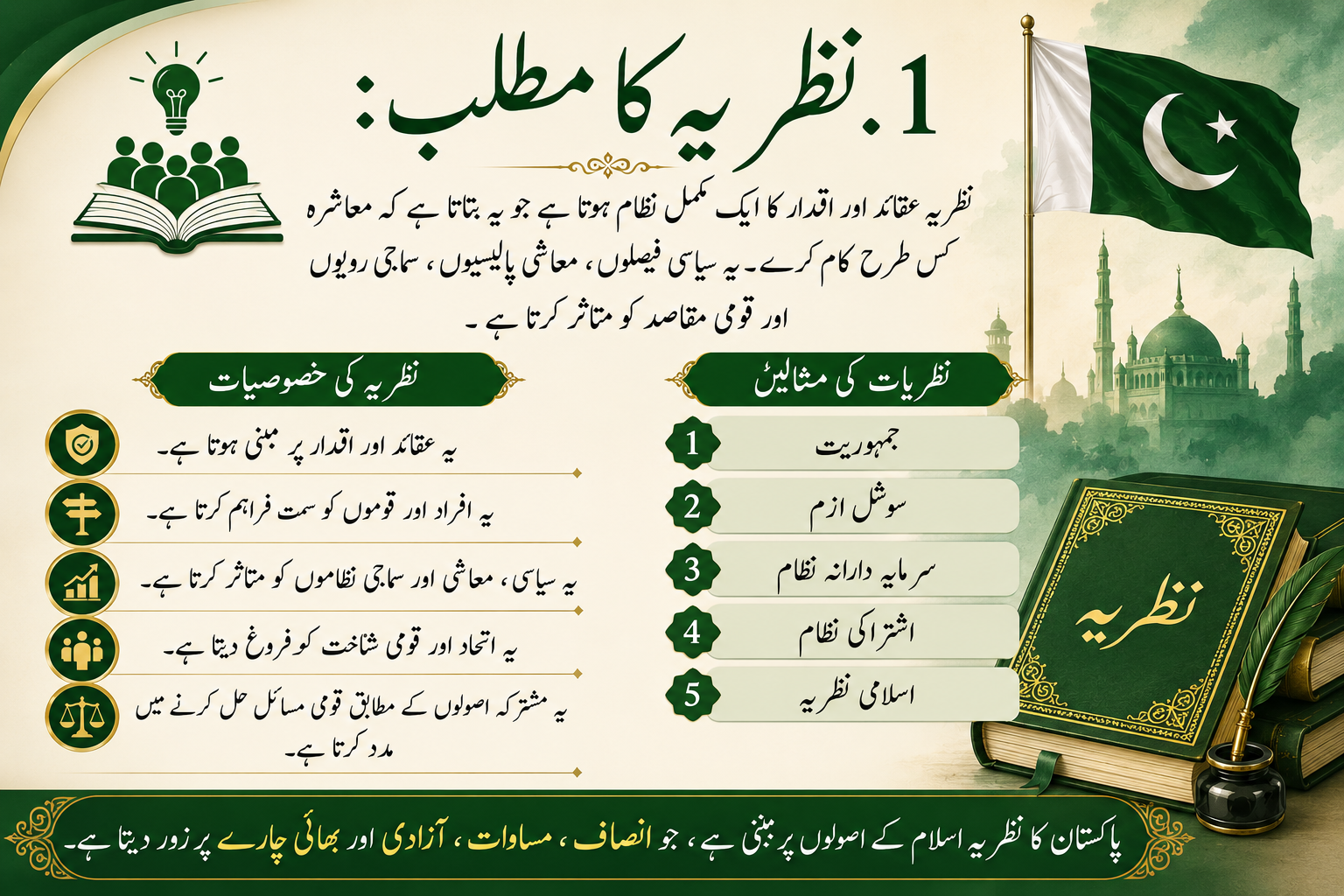
1. Meaning of Ideology:
Ideology means a complete system of beliefs and values that explains how society should function. It influences political decisions, economic policies, social behavior, and national objectives.
Features of Ideology
It is based on beliefs and values.
It provides direction to individuals and nations.
It influences political, economic, and social systems.
It promotes unity and national identity.
It helps solve national problems according to shared principles.
Examples of Ideologies
Democracy
Socialism
Capitalism
Communism
Islamic Ideology
Pakistan’s ideology is based on the principles of Islam, which emphasize justice, equality, freedom, and brotherhood.
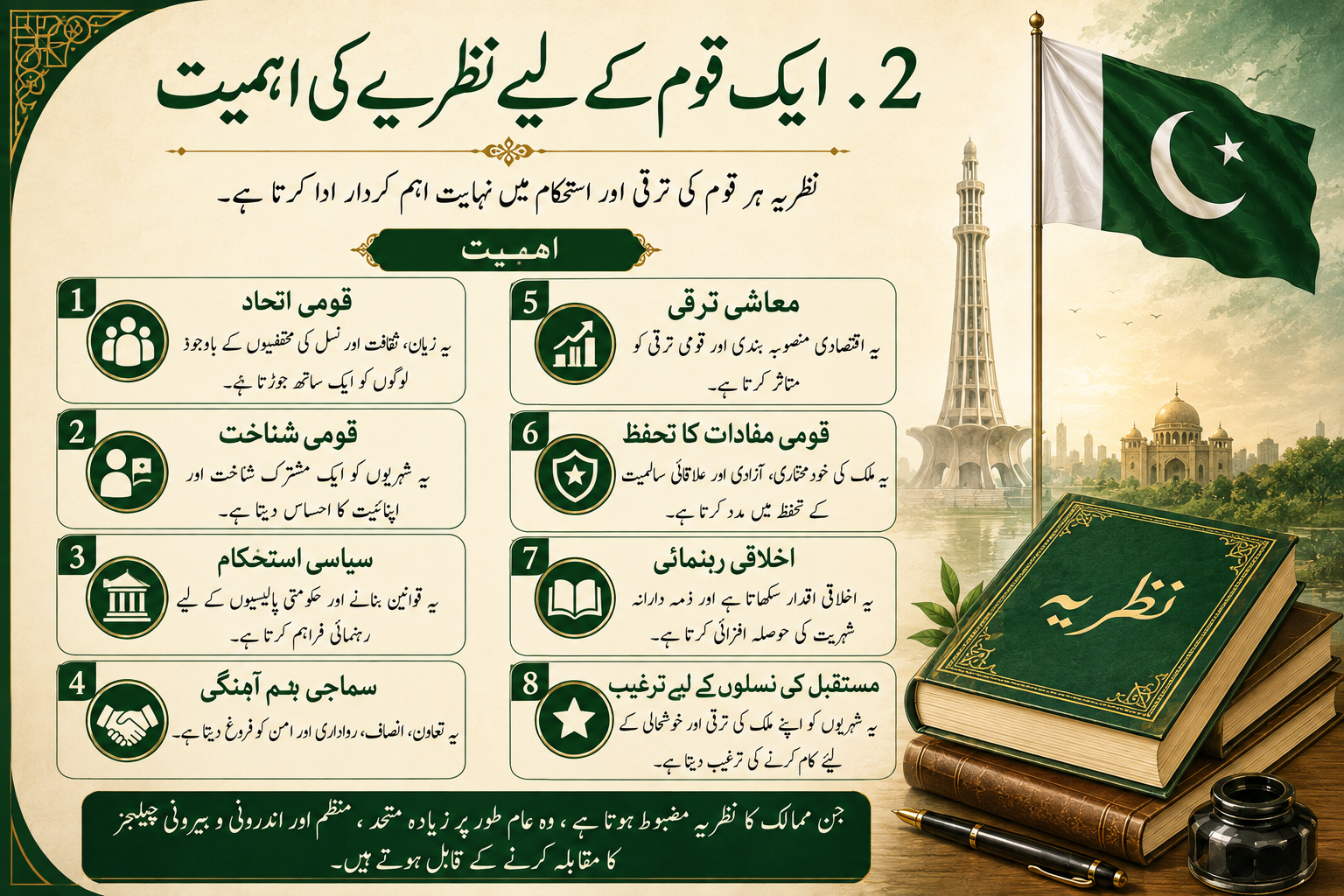
2. Importance of Ideology for a Nation
Ideology plays a vital role in the development and stability of every nation.
Importance
1. National Unity
It brings people together despite differences in language, culture, and ethnicity.
2. National Identity
It gives citizens a common identity and a sense of belonging.
3. Political Stability
It provides guidance for making laws and government policies.
4. Social Harmony
It promotes cooperation, justice, tolerance, and peace among people.
5. Economic Development
It influences economic planning and national development.
6. Protection of National Interests
It helps safeguard a country’s sovereignty, independence, and territorial integrity.
7. Moral Guidance
It teaches ethical values and encourages responsible citizenship.
8. Inspiration for Future Generations
It motivates citizens to work for the progress and prosperity of their country.
Countries with a strong ideology are generally more united, organized, and capable of facing internal and external challenges.
Relationship between Ideology and Power
Ideology and power are closely connected in political science. Ideology provides the ideas, beliefs, and values that guide a nation, while power is the ability to influence or control people and institutions. Together, ideology and power shape the political, social, and economic life of a country.
A government uses power to implement its ideology, and an ideology gives legitimacy and direction to the use of power. Without ideology, power may become oppressive, while without power, ideology may remain only a set of ideas that cannot be put into practice.
1. Meaning of Power:
Power is the ability of an individual, group, or government to influence the behavior and decisions of others. In politics, power enables the state to make laws, maintain order, protect national interests, and implement policies.
Power may be exercised through:
Government institutions
Laws and constitutions
Military and police
Public opinion
Economic resources
Diplomacy
Power should be used responsibly and according to justice and the rule of law.
2. Relationship between Ideology and Power
Ideology and power depend upon each other.
a) Ideology Gives Legitimacy to Power
Governments justify their actions through ideology. Citizens are more likely to obey laws when they believe the government is working according to accepted values and principles.
For example, Pakistan’s constitutional principles are based on Islamic values, giving moral legitimacy to many state policies.
b) Power Implements Ideology
An ideology becomes effective only when the government has the power to enforce laws and policies.
Examples include:
Making laws according to constitutional principles.
Promoting education based on national values.
Protecting citizens’ rights.
Maintaining law and order.
c) Power Protects National Ideology
Every country protects its ideology through:
Education
Media
National institutions
Constitution
Armed forces
These institutions strengthen national unity and preserve the country’s identity.
d) Ideology Directs the Use of Power
Power without moral guidance may lead to dictatorship and injustice. Ideology provides ethical principles that guide rulers in making fair decisions.
A government committed to justice, equality, and human rights uses power for public welfare rather than personal benefit.
3. Types of Political Power
Political power exists in different forms.
i. Political Power
The authority to govern the country through elected representatives and public institutions.
ii. Economic Power
Control over financial resources, industries, trade, and national wealth.
iii. Military Power
The ability to defend national sovereignty and maintain security.
iv. Social Power
The influence of religion, education, media, culture, and public opinion on society.
v. Diplomatic Power
The ability to influence other countries through peaceful relations and foreign policy.
4. Importance of the Relationship between Ideology and Power
The relationship between ideology and power is important because it:
Maintains national unity.
Protects national sovereignty.
Guides government policies.
Promotes justice and equality.
Strengthens democratic institutions.
Encourages economic development.
Ensures political stability.
Builds trust between citizens and the government.
Countries that successfully balance ideology and power usually enjoy greater peace, stability, and development.
5. Examples of Ideology and Power
Pakistan
Pakistan’s ideology is based on Islamic principles. The Constitution of 1973 declares Islam as the state religion and emphasizes democracy, justice, equality, and social welfare. Government institutions exercise power according to constitutional provisions.
United States
The United States emphasizes democracy, liberty, individual rights, and free-market capitalism. Government power is exercised through the Constitution and democratic institutions.
China
China follows socialist principles under the leadership of the Communist Party. State power is used to implement economic planning and national development policies.
6. Challenges in Balancing Ideology and Power
Governments may face several challenges, including:
Political instability
Corruption
Abuse of power
Extremism
Weak institutions
Foreign interference
Economic inequality
These challenges can weaken both ideology and effective governance if not addressed properly.
Conclusion
Ideology and power are inseparable elements of every political system. Ideology provides the vision, values, and goals of a nation, while power enables the government to implement those goals. A successful state uses power responsibly and in accordance with its ideology, constitution, and the rule of law. When ideology guides power with justice, equality, and accountability, it promotes national unity, political stability, and sustainable development.
Ideology in Contemporary Politics
Introduction
In the modern world, ideology continues to play a central role in politics. It influences how governments make decisions, how political parties formulate their policies, and how citizens understand national and international issues. Contemporary politics deals with current political developments, including democracy, human rights, economic growth, globalization, climate change, and international relations. Every country follows an ideology that shapes its political system and national priorities.
1. Meaning of Contemporary Politics
Contemporary politics refers to the political ideas, events, and policies that affect the world today. It focuses on present-day issues and the role of governments in solving national and global challenges.
Contemporary politics includes:
Democratic governance
Human rights
Economic development
Foreign policy
National security
Climate change
Globalization
Technology and digital governance
Ideology provides guidance for dealing with these modern issues.
2. Role of Ideology in Contemporary Politics
Ideology influences almost every aspect of political life.
a) Shaping Government Policies
Governments prepare policies according to their ideological beliefs. Their ideology determines priorities in education, healthcare, taxation, welfare, and economic planning.
For example:
Democratic governments emphasize public participation and civil liberties.
Socialist governments focus on social welfare and reducing inequality.
Islamic political thought emphasizes justice, equality, and welfare.
b) Guiding Political Parties
Political parties are formed around specific ideologies. Their election manifestos reflect their beliefs and goals.
Political parties may support:
Democracy
Socialism
Conservatism
Liberalism
Nationalism
Religious values
Citizens often choose parties whose ideology matches their own beliefs.
c) Protecting National Identity
Ideology strengthens national identity by promoting common values, history, culture, and traditions. It helps unite people despite differences in language, ethnicity, or region.
For Pakistan, the ideology based on Islamic principles has been an important source of national unity.
d) Influencing Foreign Policy
Countries develop foreign policies according to their national interests and ideological beliefs.
Examples include:
Promoting peace and cooperation.
Supporting friendly nations.
Protecting national sovereignty.
Participating in international organizations.
Expanding trade and diplomatic relations.
3. Major Political Ideologies in the Contemporary World
A. Democracy
Democracy is a political system in which people elect their representatives through free and fair elections.
Features
Rule of law
Independent judiciary
Protection of human rights
Freedom of speech
Accountability
Free elections
Examples include the United Kingdom, Canada, Japan, and many other democratic countries.
B. Liberalism
Liberalism emphasizes:
Individual freedom
Equality before law
Human rights
Freedom of religion
Freedom of expression
Limited government
It supports constitutional government and democratic institutions.
C. Conservatism
Conservatism values:
Tradition
Family values
Social stability
Respect for religion
Gradual reforms rather than sudden changes
Conservatives believe that institutions should evolve carefully while preserving national traditions.
D. Socialism
Socialism promotes:
Social justice
Economic equality
Public welfare
Government responsibility in providing education and healthcare
Reduction of income inequality
Many countries combine socialist welfare policies with democratic governance.
E. Nationalism
Nationalism encourages:
Love for one’s country
National unity
Protection of sovereignty
Preservation of culture
National development
Healthy nationalism strengthens patriotism, while extreme nationalism may create conflicts with other nations.
F. Islamic Political Thought
Islamic political ideology is based on:
Justice
Equality
Brotherhood
Rule of law
Human dignity
Social welfare
Accountability
Protection of fundamental rights
It emphasizes that rulers should govern with honesty, consultation (Shura), and fairness.
4. Ideology and Globalization
Globalization has increased interaction among countries through trade, communication, education, and technology.
Positive Effects
Better trade opportunities.
Technological advancement.
Educational cooperation.
Cultural exchange.
Economic growth.
Challenges
Cultural influence from abroad.
Economic competition.
Loss of traditional values.
Political pressures.
Countries try to protect their national ideology while benefiting from globalization.
5. Ideology and Human Rights
Modern political systems recognize the importance of protecting human rights.
These include:
Right to life.
Freedom of religion.
Freedom of expression.
Right to education.
Equality before law.
Protection from discrimination.
Different ideologies support these rights in different ways, but most modern constitutions recognize their importance.
6. Ideology and Economic Development
Economic policies often reflect ideological beliefs.
Examples:
Capitalist systems encourage private business and free markets.
Socialist systems give the government a larger role in the economy.
Mixed economies combine both approaches.
Governments aim to reduce poverty, create employment, and improve living standards through policies consistent with their ideology.
7. Ideology in Pakistan’s Contemporary Politics
Pakistan’s ideology is closely linked with the principles of Islam and democracy.
The Constitution of 1973 emphasizes:
Democracy
Federalism
Islamic principles
Social justice
Equality
Protection of minorities
Rule of law
Fundamental rights
Political parties may differ in policies, but all operate within the constitutional framework.
8. Challenges Facing Ideology in Contemporary Politics:
Modern societies face several challenges, including:
Political polarization.
Corruption.
Extremism.
Misinformation on social media.
Economic inequality.
Terrorism.
Climate change.
Weak governance.
Governments must address these issues while protecting constitutional values and national unity.
9. Importance of Ideology in the Modern World:
Ideology remains important because it:
Provides national direction.
Strengthens unity.
Promotes justice and equality.
Guides policy-making.
Protects national identity.
Encourages responsible leadership.
Supports democratic governance.
Helps achieve long-term national development.
Conclusion
Ideology continues to shape contemporary politics across the world. It influences government policies, political parties, foreign relations, economic development, and national identity. In today’s rapidly changing world, successful nations balance their ideological values with democracy, human rights, scientific progress, and international cooperation. For Pakistan, adherence to constitutional principles, justice, equality, and the welfare of all citizens remains essential for achieving peace, stability, and sustainable development. This balance enables a nation to preserve its identity while responding effectively to modern political, social, and economic challenges.
1 thought on “Introduction to Ideology”