
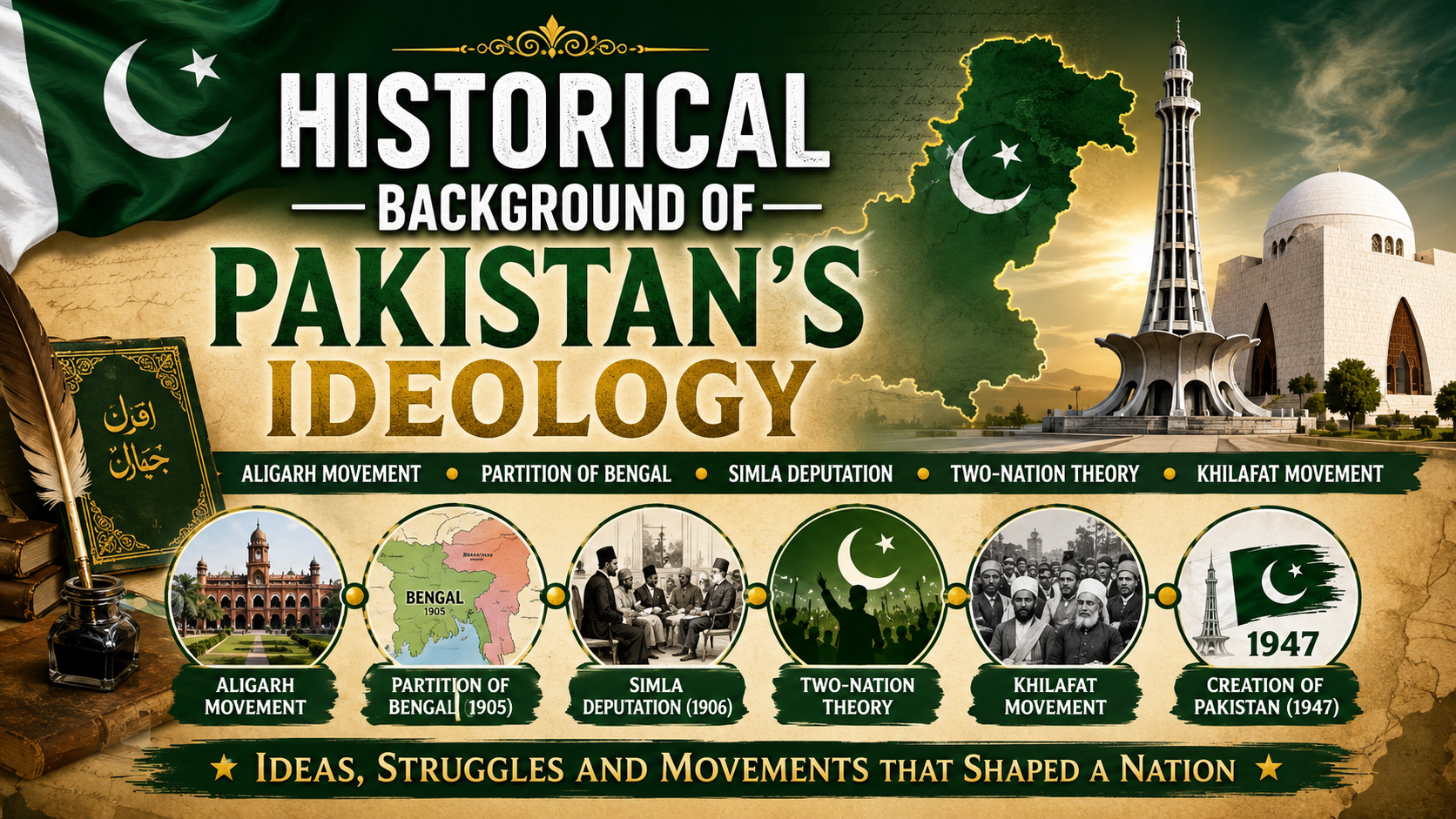
Historical Background of Pakistan’s Ideology
Introduction
The ideology of Pakistan did not emerge suddenly. It evolved over many years through political, educational, religious, and social movements led by Muslim leaders in the Indian subcontinent. Muslims feared that after the British left India, they would become a permanent minority under Hindu majority rule. Therefore, they struggled to preserve their religious, cultural, political, and economic identity.
Several important events contributed to the development of Pakistan’s ideology, including the Aligarh Movement, Partition of Bengal, Simla Deputation, Two-Nation Theory, and Khilafat Movement. These movements gradually united Muslims and ultimately led to the creation of Pakistan on 14 August 1947.
1. Aligarh Movement
Introduction
The Aligarh Movement was one of the most important reform movements in the history of Indian Muslims. It was started by Sir Syed Ahmad Khan after the War of Independence of 1857. Muslims had suffered greatly after the war because the British blamed them for the rebellion. Their educational, political, and economic conditions declined.
Sir Syed believed that the only way Muslims could regain their status was through modern education, scientific knowledge, and cooperation with the British government.
Objectives of the Aligarh Movement
The major objectives were:
To promote modern education among Muslims.
To improve the social and economic conditions of Muslims.
To remove misunderstandings between Muslims and the British.
To encourage Muslims to study science and English.
To create political awareness among Muslims.
To preserve Islamic values while accepting modern education.
Educational Reforms
Sir Syed established several educational institutions.
Scientific Society (1864)
He established the Scientific Society at Ghazipur to translate English books into Urdu so that Muslims could learn modern science and technology.
Tahzib-ul-Akhlaq
He published a journal called Tahzib-ul-Akhlaq to reform Muslim society and encourage education, morality, and social development.
Mohammedan Anglo-Oriental College (1875)
His greatest achievement was the establishment of the Mohammedan Anglo-Oriental (MAO) College at Aligarh. It later became Aligarh Muslim University in 1920.
The institution produced many educated Muslim leaders who later played an important role in the Pakistan Movement.
Political Importance
The Aligarh Movement encouraged Muslims to participate in politics and protect their separate identity. Sir Syed argued that Muslims and Hindus were two distinct communities with different religions, cultures, traditions, and interests.
His ideas later became the foundation of the Two-Nation Theory.
Achievements of the Aligarh Movement
Spread modern education among Muslims.
Improved social and economic conditions.
Produced educated Muslim leadership.
Created political awareness.
Strengthened Muslim identity.
Prepared the foundation of the Pakistan Movement.
Importance in Pakistan’s Ideology
The Aligarh Movement is regarded as the first major step toward the ideology of Pakistan because it awakened Muslims and encouraged them to protect their separate identity through education and political organization.
2. Partition of Bengal (1905)
Background
In 1905, the British Viceroy Lord Curzon divided the province of Bengal into two parts.
East Bengal and Assam (Muslim majority)
West Bengal (Hindu majority)
The British argued that Bengal had become too large to administer effectively.
Objectives of the Partition
The main objectives were:
Improve administration.
Promote development in eastern areas.
Provide educational and employment opportunities to Muslims.
Reduce administrative difficulties.
Muslim Reaction
Muslims strongly welcomed the partition because:
It created a Muslim-majority province.
Muslims received better educational opportunities.
Government jobs increased.
Political influence of Muslims improved.
Hindu Reaction
Many Hindu leaders opposed the partition because they believed it would reduce their political influence.
They started the Swadeshi Movement, boycotted British goods, and organized protests demanding cancellation of the partition.
Annulment of Partition
Due to strong Hindu opposition, the British government cancelled the partition in 1911.
This disappointed Muslims and convinced them that they needed their own political organization to protect their rights.
Importance of Partition of Bengal
The Partition of Bengal:
Increased Muslim political awareness.
Strengthened Muslim unity.
Encouraged Muslims to organize politically.
Led directly to the formation of the All-India Muslim League in 1906.
Strengthened the demand for separate political rights.
3. Simla Deputation (1906)
Introduction
The Simla Deputation was one of the most important events in the political history of Indian Muslims. It took place on 1 October 1906, when a delegation of 35 prominent Muslim leaders, led by Sir Sultan Muhammad Shah (Aga Khan III), met the British Viceroy Lord Minto at Simla.
The purpose of this meeting was to protect the political rights of Muslims and ensure that they received fair representation in government institutions. The deputation marked the beginning of organized Muslim politics in British India and played a significant role in the development of Pakistan’s ideology.
Background of the Simla Deputation
After the Partition of Bengal (1905), Muslims became more politically aware. They realized that without a united political platform, their interests could be ignored in a Hindu-majority India.
Muslim leaders believed that because Muslims had a separate religion, culture, traditions, and history, they deserved separate political rights. They decided to present their demands directly to the British government.
Objectives of the Simla Deputation
The main objectives were:
To protect the political rights of Muslims.
To demand separate electorates for Muslims.
To ensure fair representation in legislative councils.
To secure government jobs for Muslims.
To promote Muslim participation in politics.
To safeguard the separate identity of Muslims.
Main Demands
The Muslim delegation requested:
Separate electorates for Muslims.
Representation according to Muslim political importance, not only population.
More opportunities in education and government services.
Protection of Muslim religious and cultural rights.
Response of Lord Minto
Lord Minto warmly received the Muslim delegation and accepted many of their demands.
He assured Muslim leaders that:
Their political rights would be protected.
Separate electorates would be introduced.
Muslims would receive fair political representation.
This became a historic achievement for the Muslims of India.
Achievements of the Simla Deputation
The Simla Deputation achieved several important successes:
Recognition of Muslims as a separate political community.
Acceptance of separate electorates.
Increased Muslim confidence in politics.
Encouraged Muslim unity.
Prepared the way for the establishment of the All-India Muslim League in December 1906.
Importance in Pakistan’s Ideology
The Simla Deputation is considered a major milestone because it:
Recognized Muslims as a separate nation in politics.
Strengthened Muslim political consciousness.
Protected Muslim political rights.
Encouraged organized political struggle.
Prepared the foundation of the Pakistan Movement.
Establishment of the All-India Muslim League (1906)
Inspired by the success of the Simla Deputation, Muslim leaders established the All-India Muslim League on 30 December 1906 in Dhaka.
Objectives
Protect Muslim political rights.
Promote loyalty to the British government.
Develop unity among Muslims.
Safeguard Muslim culture and religion.
Represent Muslims in political matters.
Later, under the leadership of Quaid-e-Azam Muhammad Ali Jinnah, the Muslim League became the leading organization of the Pakistan Movement.
4. Two-Nation Theory
Introduction
The Two-Nation Theory is the ideological foundation of Pakistan. It states that Muslims and Hindus were two separate nations because they followed different religions, cultures, traditions, languages, laws, and ways of life.
According to this theory, Muslims needed a separate homeland where they could freely practice Islam and develop according to their own beliefs and values.
Origin of the Two-Nation Theory
The idea was first clearly expressed by Sir Syed Ahmad Khan after 1857.
He believed that:
Muslims and Hindus had different civilizations.
Their religions were different.
Their customs and traditions were different.
Their political interests were different.
Therefore, they could not permanently live under one political system dominated by the majority.
Development of the Theory
Several leaders strengthened this idea.
Sir Syed Ahmad Khan
He emphasized Muslim education and separate identity.
Allama Muhammad Iqbal
In his Allahabad Address (1930), he proposed a separate Muslim state in north-western India where Muslims could develop according to Islamic principles.
Quaid-e-Azam Muhammad Ali Jinnah
Jinnah transformed the Two-Nation Theory into a political movement. He argued that Muslims were a separate nation entitled to their own independent homeland.
Basis of the Two-Nation Theory
The theory was based on several differences:
Religious Differences
Muslims believe in Islam, while Hindus follow Hinduism.
Cultural Differences
Their customs, festivals, traditions, and social practices were different.
Social Differences
Marriage laws, food habits, inheritance laws, and family systems differed greatly.
Political Differences
Muslims wanted constitutional protection of their political rights.
Historical Differences
Both communities had different historical experiences and heroes.
Importance of the Two-Nation Theory
The Two-Nation Theory:
United Muslims of the subcontinent.
Strengthened Muslim national identity.
Inspired the Pakistan Movement.
Protected Muslim religious and cultural values.
Led to the demand for an independent homeland.
Became the ideological basis of Pakistan.
Criticism and Historical Significance
Although some leaders opposed the theory and preferred a united India, the Muslim leadership believed that constitutional safeguards alone would not adequately protect Muslim interests in a Hindu-majority state.
From the perspective of Pakistan Studies, the Two-Nation Theory is regarded as the guiding principle that led to the establishment of Pakistan on 14 August 1947.
5. Khilafat Movement (1919–1924)
Introduction
The Khilafat Movement was one of the most important political and religious movements in the history of Indian Muslims. It was launched after World War I to protect the Ottoman Caliphate (Khilafat), which was regarded by many Muslims as a symbol of unity in the Muslim world.
After the defeat of the Ottoman Empire, the Allied Powers planned to weaken and eventually abolish the Caliphate. Indian Muslims strongly opposed these actions and started the Khilafat Movement to defend the institution of the Caliph.
The movement not only strengthened Muslim unity but also increased political awareness among Indian Muslims. It became an important step in the development of Pakistan’s ideology.
Background of the Khilafat Movement
During World War I (1914–1918), the Ottoman Empire fought against Britain and its allies. After the war, the victorious Allied Powers imposed harsh conditions on Turkey through the Treaty of Sèvres (1920).
Indian Muslims feared that:
The Ottoman Caliph would lose his authority.
The holy places of Islam might come under foreign control.
Muslim unity throughout the world would be weakened.
As a result, Muslim leaders launched the Khilafat Movement.
Leaders of the Khilafat Movement
The movement was led by several prominent Muslim leaders, including:
Maulana Muhammad Ali Johar
Maulana Shaukat Ali
Maulana Abul Kalam Azad
Hakim Ajmal Khan
Maulana Abdul Bari
These leaders organized public meetings, delivered speeches, and encouraged Muslims to unite for the protection of the Caliphate.
Objectives of the Khilafat Movement
The main objectives were:
To protect the Ottoman Caliphate.
To safeguard the holy places of Islam.
To unite Muslims throughout the world.
To oppose unjust British policies.
To promote political awareness among Indian Muslims.
To defend Muslim religious identity.
Activities of the Movement
The Khilafat leaders organized:
Public meetings.
Political rallies.
Peaceful demonstrations.
Boycott of British goods.
Awareness campaigns.
Cooperation with other nationalist movements for a period.
Thousands of Muslims actively participated in these activities.
End of the Khilafat Movement
In 1924, Mustafa Kemal Atatürk abolished the Ottoman Caliphate in Turkey as part of his reforms.
As a result:
The Khilafat Movement came to an end.
Its immediate objective could not be achieved.
However, the movement left a lasting impact on Muslim political thinking in the Indian subcontinent.
Achievements of the Khilafat Movement
Although it failed to save the Caliphate, it achieved several important goals:
Increased political awareness among Muslims.
Strengthened Muslim unity.
Encouraged participation in political activities.
Produced new Muslim leadership.
Inspired future political movements.
Prepared Muslims for the Pakistan Movement.
Importance in Pakistan’s Ideology
The Khilafat Movement occupies an important place in the historical development of Pakistan’s ideology because:
It united Muslims on religious and political grounds.
It strengthened the feeling of Muslim nationhood.
It increased awareness of Muslim identity.
It prepared Muslims for future political struggles.
It contributed to the demand for a separate homeland.
1 thought on “Historical Background of Pakistan’s Ideology”