
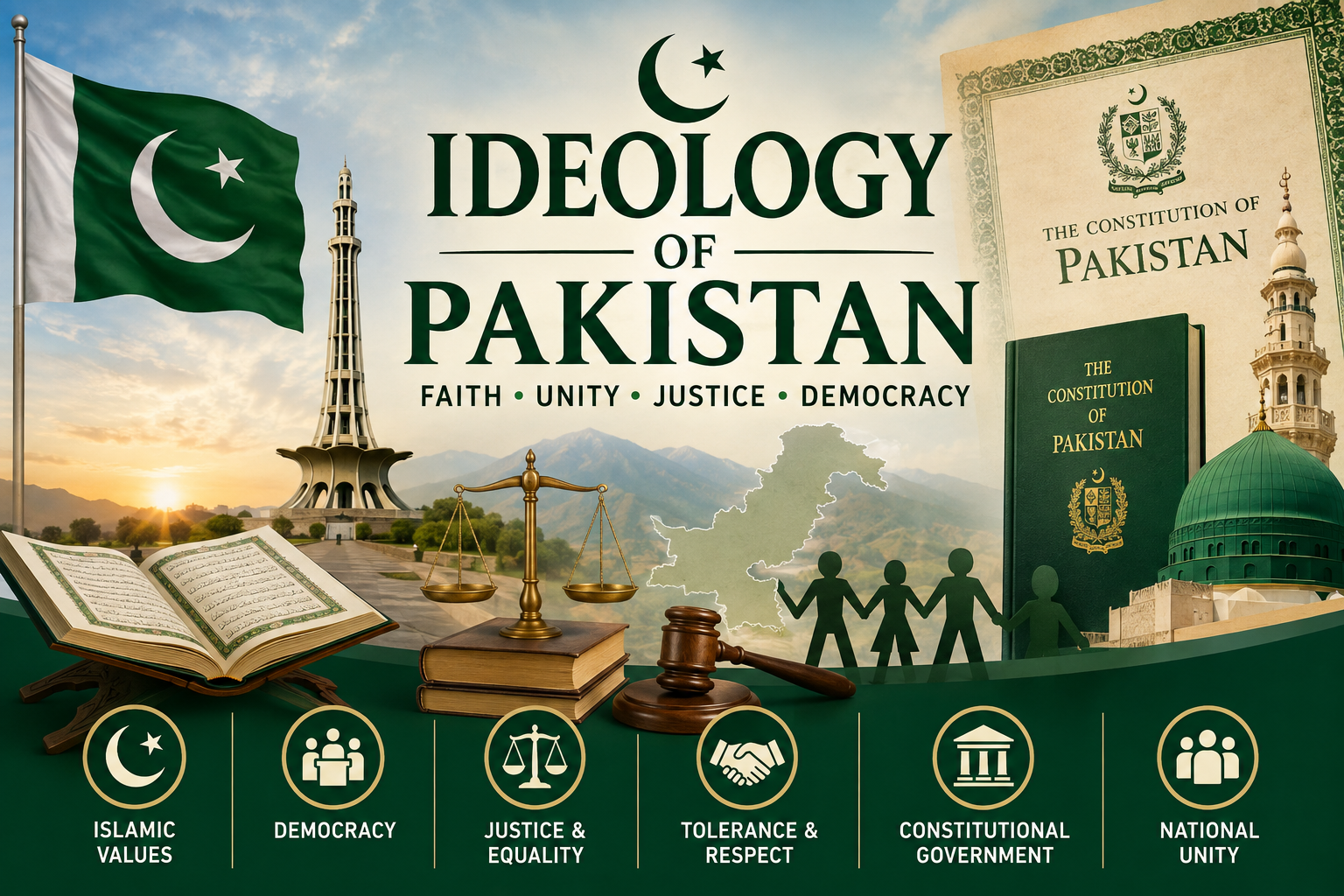
Ideology of Pakistan
Introduction
The ideology of Pakistan is the set of beliefs, values, and principles that inspired the Muslims of the Indian subcontinent to struggle for a separate homeland. It is based on the idea that Muslims have a distinct religious, cultural, social, and political identity that should be protected. Pakistan was created on 14 August 1947 to enable Muslims to live according to the teachings of Islam while ensuring justice, equality, and freedom for all citizens.
The ideology of Pakistan is not limited to religion alone. It also includes democracy, constitutionalism, social justice, national unity, and respect for human rights. The Constitution of Pakistan declares Islam as the state religion while guaranteeing the rights of minorities to practice their faith freely.
1. Components of the Ideology of Pakistan
The major components of the ideology of Pakistan are:
1. Islam
Islam is the foundation of Pakistan’s ideology. The Quran and Sunnah provide guidance for individual and collective life. Islamic principles encourage justice, equality, honesty, compassion, and accountability.
2. Two-Nation Theory
The Two-Nation Theory states that Muslims and Hindus were two separate nations because they had different religions, cultures, traditions, and ways of life. This theory became the basis for the demand for Pakistan.
3. Democracy
Pakistan follows a democratic system where people elect their representatives through free and fair elections. Democracy ensures participation of citizens in governance and protects their political rights.
4. Social Justice
Islam emphasizes justice without discrimination. The state is responsible for providing equal opportunities, protecting the weak, reducing poverty, and ensuring fairness before the law.
5. Equality
All citizens are equal before the law regardless of religion, ethnicity, language, or gender. Equal rights strengthen national unity.
6. National Unity
Pakistan consists of different provinces, languages, and cultures. National unity promotes harmony, cooperation, and patriotism among all citizens.
7. Constitutional Government
The country is governed according to the Constitution of Pakistan, which defines the powers of the government and protects the rights of citizens.
2. Sovereignty
Meaning
Sovereignty means the supreme authority of a state to govern itself independently without external interference. In Pakistan, sovereignty belongs to Almighty Allah, while the people exercise authority through their elected representatives according to the Constitution.
Sovereignty in Pakistan
The Constitution declares that all authority belongs to Allah, and the people exercise this authority as a sacred trust. Pakistan is an independent and sovereign state responsible for protecting its territorial integrity and national interests.
Importance of Sovereignty
Protects Pakistan’s independence.
Ensures national security.
Prevents foreign interference.
Enables independent decision-making.
Protects territorial integrity.
Strengthens democratic institutions.
Preserves national dignity.
3. Islamic Identity
Meaning
Islamic identity refers to the beliefs, values, and way of life based on the teachings of Islam. Pakistan was established so Muslims could preserve and develop their religious and cultural identity.
Features of Islamic Identity
Faith in One Allah
Belief in the oneness of Allah is the foundation of Islamic identity.
Quran and Sunnah
The Quran and the teachings of Prophet Muhammad (PBUH) guide Muslims in personal, social, political, and economic matters.
Justice
Islam teaches fairness and equal treatment for everyone.
Equality
All human beings are equal regardless of race, wealth, or social status.
Brotherhood
Islam promotes unity, cooperation, and mutual respect among Muslims.
Moral Values
Truthfulness, honesty, kindness, patience, and responsibility are essential Islamic values.
Education
Islam encourages acquiring knowledge and promoting scientific and intellectual development.
Importance of Islamic Identity
Preserves Muslim culture.
Promotes ethical values.
Strengthens national unity.
Encourages social justice.
Provides moral guidance.
Inspires responsible citizenship.
4. Tolerance and Religious Freedom
Meaning of Tolerance
Tolerance means respecting the beliefs, opinions, and practices of others even when they differ from one’s own.
Religious Freedom
Religious freedom means every citizen has the right to practice, profess, and propagate their religion according to the law.
Islamic Perspective
Islam teaches respect for people of all religions. The Quran prohibits forcing anyone to accept Islam and emphasizes justice and kindness toward all communities.
Constitutional Protection
The Constitution guarantees:
Freedom to profess and practice religion.
Protection of places of worship.
Equal protection under the law.
Freedom to establish religious institutions.
Equal citizenship rights.
Importance
Promotes peace and harmony.
Reduces religious conflicts.
Protects minority rights.
Encourages mutual respect.
Strengthens national unity.
Improves Pakistan’s international image.
5. Political Ideologies of Pakistan
Pakistan’s political system combines Islamic principles with democracy and constitutional governance.
Islamic Democracy
Pakistan follows an Islamic democratic system where sovereignty belongs to Allah, while elected representatives govern according to the Constitution and Islamic values.
Parliamentary Democracy
Pakistan has a parliamentary system.
The Prime Minister is the head of government.
The President is the constitutional head of state.
Parliament makes laws.
The judiciary ensures justice and interprets the Constitution.
Federalism
Pakistan is a federation consisting of Punjab, Sindh, Khyber Pakhtunkhwa, and Balochistan. Powers are shared between the federal and provincial governments.
Rule of Law
Everyone, including government officials, is subject to the law. The judiciary protects constitutional rights and ensures justice.
Fundamental Rights
The Constitution guarantees:
Right to life and liberty.
Freedom of speech.
Freedom of religion.
Equality before the law.
Right to education (subject to constitutional provisions).
Freedom of association.
Social Welfare
Pakistan aims to establish a welfare state by reducing poverty, promoting education, improving healthcare, and providing equal opportunities.
National Integration
Political stability and unity among provinces, ethnic groups, and communities are essential for Pakistan’s development.
Challenges to the Ideology of Pakistan
Political instability.
Corruption.
Economic inequality.
Extremism and intolerance.
Weak governance.
Lack of quality education.y
Provincial and ethnic divisions.
External security challenges.
Measures to Strengthen the Ideology of Pakistan
Promote quality education.
Strengthen democracy and constitutional rule.
Ensure justice and accountability.
Encourage tolerance and interfaith harmony.
Improve economic opportunities.
Protect minority rights.
Promote national unity and patriotism.
Develop responsible and transparent institutions.
Conclusion
The ideology of Pakistan is founded on Islamic principles, democracy, social justice, equality, sovereignty, and national unity. These principles guided the creation of Pakistan and continued to shape its constitutional and political system. Sovereignty ensures the country’s independence, Islamic identity provides moral and cultural guidance, tolerance and religious freedom promote peaceful coexistence, and democratic institutions help protect the rights of citizens. By strengthening education, justice, good governance, and national unity, Pakistan can continue to fulfill the ideals envisioned by its founders and build a peaceful, prosperous, and inclusive society.